
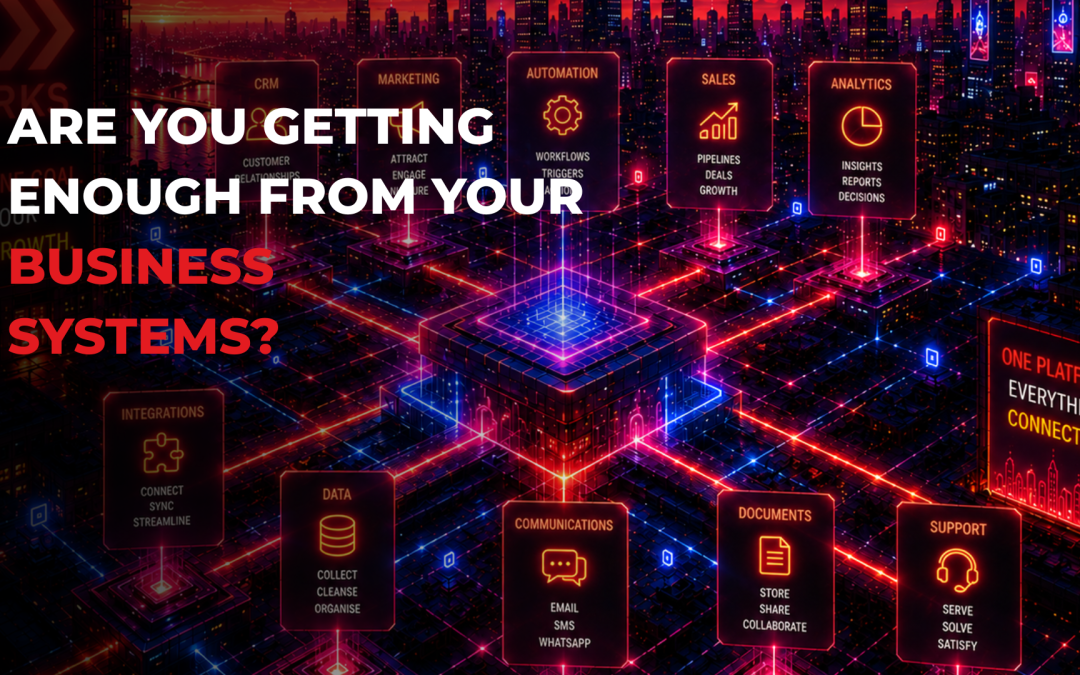
When a business starts experiencing problems with its systems, the immediate reaction is often to look for another piece of software.
Perhaps customer information is difficult to find, follow-up actions are being missed or staff spend too much time copying details from one place to another. A new platform appears to offer the answer.
Sometimes it does. However, many businesses already own technology capable of doing far more than they currently get from it.
The problem may be that the software was never fully configured, people use it inconsistently or important information cannot move between different systems. Adding another platform can simply create one more place to check and manage.
Before investing in something new, it is worth asking a simpler question:
Are we getting enough from the systems we already have?
Are You Getting Enough From Your Business Systems?
Most systems problems do not announce themselves as systems problems.
Instead, they appear as small frustrations that gradually become part of the working day.
You may find that:
- Customer information is stored in several different places.
- Staff maintain separate spreadsheets because they do not trust the main system.
- The same information is entered more than once.
- Follow-up depends on somebody remembering what to do.
- Different people complete the same task in different ways.
- Reports require manual checking before anyone believes them.
- Staff only use a small part of the software available to them.
Individually, these issues can seem manageable. Together, they create unnecessary administration and make it harder to understand what is happening across the business.
Buying another system will not automatically resolve any of them.
Three Reasons Good Systems Underperform
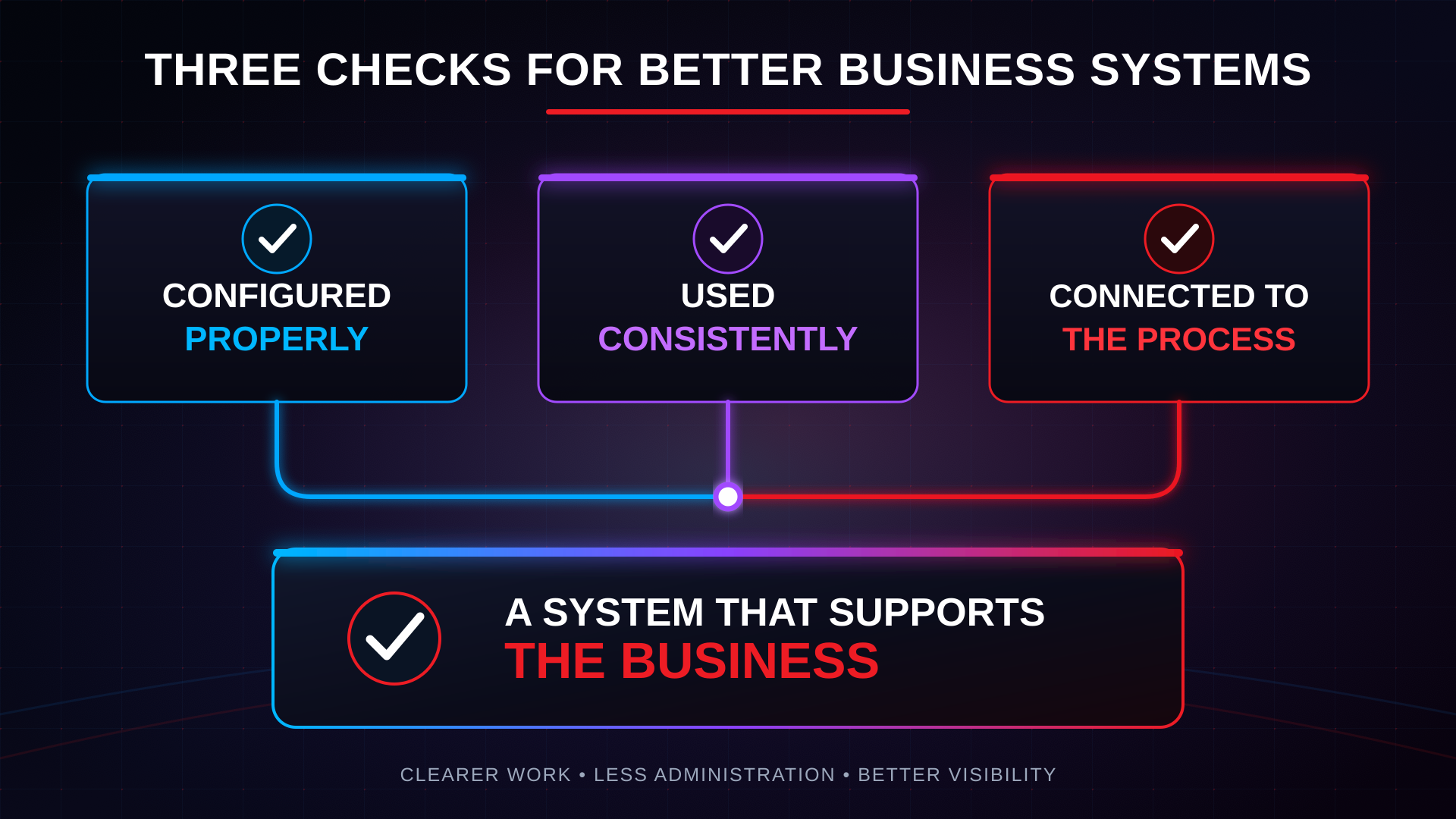
A capable system can still produce disappointing results. In our experience, this usually comes back to three broad issues.
1. The System Was Never Fully Set Up
Many businesses start using new software under pressure.
The immediate priority is getting it live, importing some data and enabling the most important function. The intention is often to return later and complete the setup.
That second stage does not always happen.
Useful features remain switched off. Workflows are left unfinished. Pipelines do not reflect the real sales process and reports cannot provide useful management information because the right data is not being captured.
The business may be paying for a capable platform while only using a fraction of what it can do.
2. People Use the System Differently
Even a well-configured system will struggle if everybody uses it in their own way.
One person may record every interaction carefully, while another keeps notes in their inbox. Somebody else may maintain a personal spreadsheet because it feels quicker or more familiar.
The result is an incomplete picture of the customer relationship.
This is not always a training issue. Sometimes the agreed process is unclear, the system contains unnecessary steps or using it properly takes longer than working around it.
Consistency improves when the process makes sense and the system supports the way people actually work.
3. Information Does Not Flow Between Systems
A business may have good individual tools that do not work particularly well together.
An enquiry arrives through the website, but somebody must copy it into the CRM. Customer details sit in the CRM, while email conversations remain in separate inboxes. Marketing activity takes place on another platform with no clear connection to the sales process.
Each system may perform its own job, but the gaps between them create extra work and increase the chance of information being missed.

A Common Example: The Underused CRM
Imagine a business that already owns a CRM system.
The software can capture website enquiries, send an acknowledgement, assign responsibility, create follow-up tasks and remind somebody when an action becomes overdue.
However, the website form is not connected to it. Staff add contacts manually, opportunities are not moved through the pipeline and follow-up remains dependent on diaries and inboxes.
The business may conclude that the CRM does not work and start searching for a replacement.
The real problem is that the existing system was never set up to support the complete process.
Replacing it without resolving that underlying issue risks creating the same problem on a different platform.
Is the Problem the Software, the Process or Its Use?
Before changing systems, look at the process the software is meant to support.
Start by asking:
- What should the process achieve?
- What starts it?
- What should happen next?
- Who is responsible at each stage?
- What information needs to be recorded?
- Where are delays or mistakes occurring?
- Which steps are being completed outside the main system?
This can reveal whether the problem sits with the software or somewhere else.
If nobody can clearly explain the process, changing technology is unlikely to help. The process may need simplifying first.
If the process is clear but the system does not reflect it, better configuration may solve the problem.
If the system works but people avoid using it, the business needs to understand why. Training could help, although the answer may involve removing unnecessary steps or making responsibilities clearer.
If information is repeatedly copied between platforms, an existing integration or automation may remove that work.
We explored the importance of starting with the process in AI, Automation or Both: Where Should a Small Business Start?.
Carry Out a Simple Business Systems Audit
You do not need to begin with a complicated technical review.
Create a list of the systems your business currently uses and record:
- The purpose of each system
- Who uses it
- The information held within it
- What information enters the system
- Where that information needs to go next
- Any spreadsheets or workarounds used alongside it
- Any information that is copied or entered again elsewhere
- Features you pay for but do not currently use
Include marketing platforms, customer databases, accounting software, booking systems, project-management tools and shared spreadsheets.
You may discover duplication you were not aware of. You may also find that nobody is quite sure which system should hold the definitive customer record.
Improve, Connect, Replace or Remove
Once you understand the current position, each system will usually need one of four actions.
Improve it
The system is broadly right but needs better configuration, cleaner data, clearer processes or additional training.
Connect it
The system performs its role, but information needs to move more effectively between it and another platform.
Replace it
The business has a clear requirement that the existing software genuinely cannot meet, or continuing to use it creates unreasonable cost, risk or complexity.
Remove it
The system duplicates another platform, no longer serves a useful purpose or creates more administration than it saves.
This review may still lead to purchasing new software. The difference is that the decision will be based on a defined requirement rather than a general feeling that the current arrangement is not working.
When New Software Really Is the Answer
There are times when replacing or adding software is entirely justified.
Your business may have outgrown the current platform. An important feature may be missing, support may be poor or the software may no longer connect with the other systems you rely upon.
A new system can also make sense when several separate tools can be replaced by one platform, reducing duplication and giving the business a clearer view of its customers and activity.
The important point is to understand what the new system must improve before making the decision.
Otherwise, it is easy to buy another subscription without removing any of the existing problems.
Get More From the Systems Supporting Your Marketing and Sales
Business software should make work clearer, reduce avoidable administration and help people take the right action at the right time.
If your CRM, lead-management or marketing systems are creating work rather than removing it, we can help you review how they are currently being used.
We look at the process, the way the system has been configured and how information moves between different platforms. From there, we can identify whether the best next step is to improve what you already have, connect it more effectively or consider a different solution.
If you would like to discuss how your existing marketing and customer systems could work harder for your business, please contact Red Knight Solutions.