
AI has become difficult to avoid.
New tools appear almost every week, existing software keeps adding AI features and businesses are regularly told that they need to start using it or risk being left behind.
That creates understandable pressure to do something. The trouble is that “we need to use AI” is not a particularly useful business objective.
A better place to start is with the problem you are trying to solve.
Perhaps enquiries are taking too long to answer. Your team may be spending hours copying information between systems. Important actions might be getting missed, or you may simply want to reduce the repetitive administration involved in running the business.
Once the required outcome is clear, you can decide whether the answer involves AI, automation, a combination of the two or simply improving the process you already have.
What is the difference between AI and automation?
AI and automation are often discussed together, but they perform different roles.
Automation follows predefined instructions. Something happens, a rule is applied and the system completes the next action.
AI is more useful when the work involves interpreting information, recognising patterns, working with language or producing a draft.
A straightforward way to think about it is:
- Automation follows rules.
- AI interprets information that may vary.
- People provide judgement, context and accountability.
Many effective business processes use a combination of all three.
What is business automation good at?
Automation works particularly well when a task is repetitive and the required action can be clearly defined.
For example, when somebody completes an enquiry form, an automated process could:
- Create or update their contact record
- Send an acknowledgement
- Notify the right person
- Create a follow-up task
- Add the enquiry to a sales pipeline
- Issue a reminder if nobody acts within an agreed period
The system does not need to decide whether following up is a good idea. The business has already decided that every enquiry should be acknowledged and assigned to someone.
Other useful examples include appointment reminders, review requests, recurring tasks, internal notifications and moving information between connected systems.
Good automation removes avoidable administration and makes it easier for people to complete work consistently.
It is less successful when the rules are unclear or the process has so many exceptions that nobody can agree what should happen next.
What is AI good at?
AI becomes useful when the information changes from one situation to another and some interpretation is required.
That could include:
- Summarising notes from a meeting
- Producing the first draft of an email
- Extracting key information from a document
- Categorising an incoming enquiry
- Identifying common themes in customer feedback
- Suggesting ideas for an article or social media post
- Turning a long piece of information into a shorter summary
These are tasks where the format, language or subject matter may vary.
AI can often complete the first stage quickly, but that does not mean its output should automatically be treated as accurate or ready to use.
A draft email can be checked before it is sent. A meeting summary can be reviewed against the original notes. A suggested category can be confirmed or corrected.
When should a small business use both AI and automation?
Many useful processes need a combination.
Imagine that a potential customer sends an enquiry containing several questions about your services.
Automation can capture the enquiry, create the contact record and send an immediate acknowledgement.
AI could summarise the message, identify what the person is asking about and prepare a first draft of a response.
A person still needs to consider whether that response is accurate, appropriate and commercially sensible.
Once the response has been approved, automation can record the next action, schedule follow-up and make any delay visible.
The complete process might look like this:
- The enquiry is received and recorded automatically.
- AI summarises or categorises the information.
- The enquiry is routed to the appropriate person.
- That person reviews it and decides what should happen.
- The next action and date are recorded.
- Reminders or escalations are triggered if the action becomes overdue.
Each part of the process is handled in the most appropriate way.
It also connects with the principles covered in our earlier article, What Should Happen After Someone Contacts Your Business?. A reliable process still needs an owner, a clear next action and a date, regardless of how much technology sits behind it.
How much human oversight does AI need?
The amount of human oversight should reflect the consequences of getting something wrong.
Using AI to produce an internal summary of a meeting presents a different level of risk from allowing it to send pricing information, respond to a complaint or provide advice to a customer.
Before allowing AI to complete a task without approval, consider:
- What happens if the information is incorrect?
- Could it affect a customer or member of staff?
- Could it create a financial, legal or reputational problem?
- Is the decision based on information the system may not have?
- Does somebody need to take responsibility for the outcome?
For lower-risk tasks, a quick review may be enough. For important decisions, AI should support the person responsible rather than replace them.
The objective is to put checks in the places where mistakes matter.
Be careful what information you give to AI
It is easy to paste an email, document or meeting transcript into an AI tool without thinking about the information it contains.
That information could include customer details, confidential commercial information or personal data relating to employees and suppliers.
Before using an AI tool for business information, check:
- Whether the tool has been approved for business use
- How the provider stores and uses the information entered
- Whether your data may be used to train its systems
- What privacy and security settings are available
- Whether confidential or personal information should be removed first
AI should be treated with the same care as any other business system. Convenience is not a good reason to ignore confidentiality, security or data protection.
Don’t automate a bad process
Technology cannot compensate for a process that nobody understands.
If enquiries are regularly missed because ownership is unclear, adding AI will not resolve the underlying issue. If a form asks for unnecessary information, automating it simply allows you to collect unnecessary information more efficiently.
Before introducing AI or automation, map what currently happens.
Identify:
- What starts the process
- Which information is required
- Who is responsible
- What decisions need to be made
- Where delays occur
- Which steps add value
- What needs to be recorded
- How completion is confirmed
You may discover that some steps can be removed before any new technology is introduced.
A simpler process is usually easier to automate, easier for people to follow and easier to improve later.
AI, automation or both? A simple way to decide
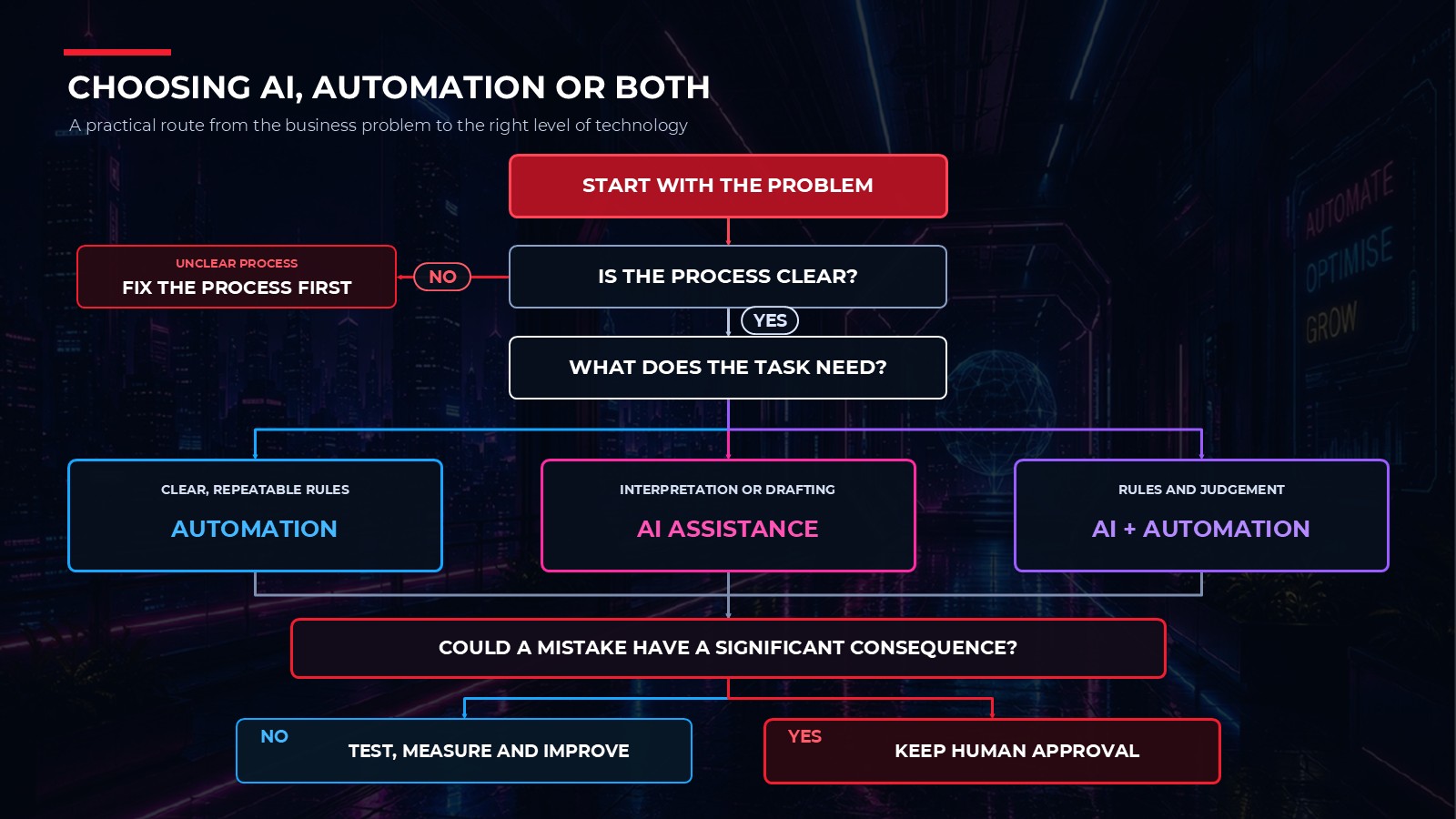
Consider the nature of the task, the information involved and the consequences of an error.
A rules-based task may be suited to automation. A task involving interpretation or drafting may benefit from AI. A process containing both elements may need a combination, with a person approving the important decisions.
If the existing process is unclear or inconsistent, fix that first.
Where should a small business start?
Start with one task rather than trying to transform the whole business.
A good first project is usually something that is:
- Repetitive
- Time-consuming
- Completed frequently
- Currently handled reasonably consistently
- Easy to measure
- Relatively low risk if the first version needs adjusting
You might choose the way meeting notes are summarised, how new enquiries are acknowledged or how overdue follow-up tasks are identified.
Write down what currently happens and ask:
- What problem are we trying to solve?
- Which parts follow clear rules?
- Which parts require interpretation?
- Where is human judgement necessary?
- What could go wrong?
- How will we know whether the change has helped?
That provides a much stronger starting point than choosing a tool first and then looking for somewhere to use it.
Find the right starting point for your business
AI and automation can save time, improve consistency and make useful information easier to access. They can also add unnecessary complexity when introduced without a clear purpose.
If everyday processes in your business take too long, rely heavily on memory or involve the same administration being repeated again and again, the first step does not have to be buying another piece of software.
We can help you map the existing process, identify where the problems occur and decide whether the solution lies in simplifying the process, making better use of your current systems or introducing appropriate automation or AI.
The objective is not to use more technology. It is to make the business work better.