

What Should Happen After Someone Contacts Your Business?
After someone contacts your business, their enquiry should be acknowledged, recorded, assigned to an owner and moved towards a clear next step. If that next step does not happen, the delay should become visible rather than allowing the opportunity to disappear quietly.
That may sound obvious, but many businesses do not have a consistent customer enquiry follow-up process. A website form generates an email, a social media message sits in an inbox, or somebody takes a telephone call and writes a note. What happens next depends on who noticed it, how busy they are and whether they remember to come back to it.
In Why Good Leads Get Lost and How to Improve Follow-Up, we looked at some of the reasons potentially valuable opportunities slip through the gaps. This article takes the next step and considers what the journey should look like from the moment somebody makes contact.
An enquiry is the beginning of an experience
When somebody completes a form, sends an email, calls your office or messages your business, they have taken a meaningful step. They may have been thinking about the problem for weeks. They may have compared several businesses before choosing yours. At the very least, they have decided that it is worth starting a conversation.
Their experience of your business begins before you deliver the service. It begins with what happens after they press Send, leave a voicemail or finish the call. A clear, helpful response creates confidence. Silence, delay or confusion can undermine it before the relationship has properly started.
1. Acknowledge that the enquiry has arrived
The first requirement is simple: let the person know their message has reached you. An automated acknowledgement can do this well, provided it sounds human and says something useful.
- Confirm that the enquiry has been received.
- Explain what will happen next.
- Set a realistic expectation for a personal response.
- Provide any useful information they may need while they wait.
An acknowledgement is not the same as answering the enquiry. Its purpose is to remove uncertainty. Avoid promising a response within an hour if the business cannot reliably achieve that. A realistic promise that is kept is better than an impressive promise that is missed.
2. Capture the enquiry in one place
The enquiry should then be recorded somewhere visible and usable. For a growing business, that usually means a CRM or another shared system rather than an individual’s email inbox, notebook or memory.
The record should preserve the original message and the context around it. Useful information might include the person’s contact details, where the enquiry came from, the service or problem involved, previous conversations, communication preferences and any date already agreed for follow-up.
Keeping the information together avoids asking the person to repeat themselves and makes it possible for somebody else to understand the situation if the usual contact is unavailable. It also gives the business a complete picture of the relationship instead of scattering it across forms, inboxes, spreadsheets and handwritten notes.
3. Give the enquiry a clear owner
Every new enquiry needs somebody who is responsible for progressing it. This matters even in a very small business. In a larger team, an unassigned enquiry can be visible to several people while each assumes that somebody else is dealing with it.
Ownership does not mean one person must do everything. It means one person is responsible for making sure the appropriate next step happens. The important question is not only, ‘Have we received it?’ It is, ‘Who is responsible for what happens next?’
4. Make the first personal response useful
Speed is important, but speed on its own is not enough. A rushed template that ignores the question can feel less helpful than a slightly later response that shows somebody has read and understood the message.
A useful first response should:
- Refer to what the person actually asked.
- Acknowledge the problem or objective they have described.
- Ask any questions needed to understand the situation.
- Explain the most appropriate next step.
- Help before attempting to sell.
That final point is important. A prospective customer does not necessarily need a full sales presentation. They need to know that you understand why they contacted you and can help them make progress.
5. Agree and record the next action
Every meaningful conversation should end with a clear next action. That might be a telephone call, an appointment, a request for more information, a quotation, a proposal or an agreed date to get back in touch. Sometimes the right outcome will be to refer the person elsewhere.
The action, owner and date should be recorded. ‘Follow up later’ is not a next action. ‘Rob to call on Tuesday afternoon after the client has spoken to their business partner’ is. The clearer the commitment, the less likely it is to be forgotten or misunderstood.
6. Do not allow overdue actions to disappear quietly
Recording a task is useful, but it does not guarantee that the task will happen. People get busy, priorities change and unexpected work arrives. The process therefore needs a way to identify when an agreed action is approaching its deadline or has become overdue.
Depending on the importance of the enquiry, the system might provide:
- A reminder before the action is due.
- A notification when the action becomes overdue.
- A visible overdue item in the owner’s task list.
- A further prompt if it remains incomplete.
- An escalation when an important enquiry has received no action.
- An alert when an opportunity has remained at the same stage for too long.
The aim is not to bombard people with notifications. When everything creates an alert, alerts quickly become background noise. The system should draw attention to the exceptions that genuinely require action.
7. Give owners and managers useful visibility
A business owner or manager should not have to open every contact record or repeatedly ask the team for updates. A simple dashboard or management information report can provide oversight of what is happening and highlight where attention is required.
Useful information could include:
- New enquiries received.
- Enquiries without an assigned owner.
- People still awaiting a personal response.
- Overdue tasks and next actions.
- Opportunities with no recent activity.
- Average response times.
- The number of opportunities at each stage.
- Won, lost and stalled opportunities, including the reasons where known.
A useful dashboard should tell you where attention is needed, not simply present large numbers in colourful boxes. The objective is not to monitor people for the sake of it. It is to provide an early warning when the agreed process is not being followed, a colleague needs support or opportunities are being allowed to stall.
8. Continue the conversation appropriately
No immediate reply does not always mean the person has lost interest. They may be busy, comparing options, waiting for somebody else’s input or simply not ready to decide.
A sensible follow-up sequence keeps the conversation open without becoming intrusive. Some follow-up will be personal. Other parts, such as reminders or useful supporting information, can be automated. The tone, timing and length of the sequence should reflect the type of enquiry and the likely buying decision.
There should also be a clear way to pause or stop automated activity when the person replies. Automation should support the conversation, not continue talking over it.
9. Change the journey when the person becomes a customer
Once somebody agrees to proceed, they should move from the enquiry journey into an appropriate onboarding process. They should not continue receiving messages that treat them as an undecided lead.
Depending on the business, the change in status might trigger:
- A welcome message.
- An agreement, form or request for information.
- Payment instructions.
- Appointment or delivery details.
- Internal tasks and notifications.
- A clear explanation of what happens next.
The period immediately after somebody says yes is an important part of the customer experience. A smooth handover confirms that they made a good decision. A confused one can create doubt before the work has even started.
10. Learn from what happens
The final part of the process is review. A business should periodically look at how enquiries move through the journey and where they tend to slow down or stop.
- How quickly do people receive a personal response?
- Which sources generate useful enquiries?
- How many enquiries progress to the next stage?
- Where do conversations most often stall?
- Why are opportunities won or lost?
- Are the same actions repeatedly becoming overdue?
This is not reporting for the sake of reporting. The purpose is to identify practical improvements. A recurring delay may point to a capacity problem, unclear ownership, an unnecessary step or an automation that is not working as intended.
A simple example of the journey in practice
Imagine that somebody completes an enquiry form on a business’s website. They receive an immediate acknowledgement confirming that the message has arrived and explaining when they can expect a personal response. At the same time, the enquiry is recorded in the CRM, assigned to the appropriate person and given a task to respond that morning.
After the conversation, the agreed next action and date are added to the record. If that action becomes overdue, it appears on the owner’s task list and the manager’s dashboard rather than disappearing into an inbox. If the customer agrees to proceed, they move into the onboarding process and the enquiry follow-up stops.
Nothing in that journey is particularly complicated. Its strength comes from making ownership, commitments and exceptions visible at every stage.
What does a good enquiry journey look like
The precise journey will differ between businesses, but the basic flow is straightforward.
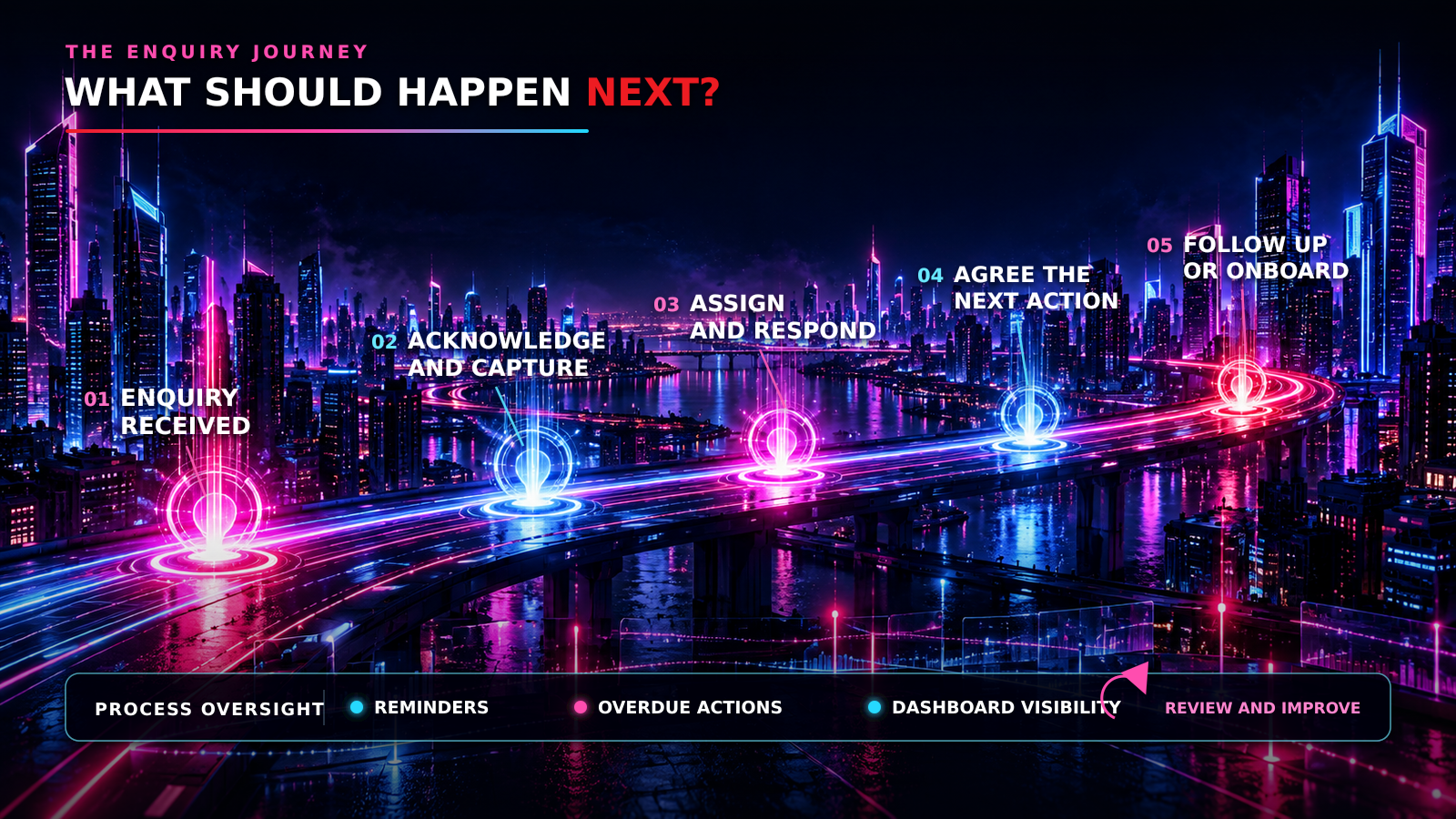
The technology involved does not need to be complicated. What matters is that the process is understood, the information is visible and the system supports people in doing what has been agreed.
Try this with one recent enquiry
Choose one genuine enquiry received during the last few weeks and follow it through the business. Ask:
- Where was it recorded?
- Who owned it?
- How quickly did the person receive a useful response?
- Was the next action clear and dated?
- What would have happened if that action became overdue?
- Could an owner or manager see its current position without asking around?
- What happened if the person did not reply?
- Can you see the final outcome?
If several of those questions are difficult to answer, the business may be relying too heavily on individual memory and good intentions. That can work when the volume is low and everybody has time. It becomes increasingly risky as the business grows or the team becomes busier.
Design the journey before choosing the technology
A CRM, dashboard or automation platform can make the process easier and more reliable, but technology cannot compensate for an unclear journey. Decide what should happen, who should be responsible and which exceptions need attention before configuring the system around it.
If this exercise has highlighted gaps in how your enquiries are handled, our Go High Level consultancy and CRM and business systems support can help you improve the pipelines, tasks, reminders, workflows and dashboards behind the process.
Whether you already use Go High Level, DM365 or another CRM, or are still deciding what your business needs, contact us to discuss the right next step.